
Introduction: Your 24/7 Team Member That Never Sleeps Imagine hiring a new team member who shows up on time, works 24/7, never gets flustered, and can handle unlimited concurrent calls—all without asking for coffee. That’s AI voice support. In seven focused days, you can stand up a production-ready pilot that fields Tier 1 queries, qualifies leads, schedules appointments, conducts post-call surveys, and updates your CRM—while slashing costs and improving customer experience.
Here’s the destination: 30–50% reduction in support costs, faster response times by 50–70%, AHT down by 35–45%, higher First Contact Resolution (FCR) by 20–40%, and measurable CSAT lift. Oh, and your agents? They’ll handle up to 3X more inquiries thanks to smart routing and AI assist. Market data shows 47% of customers prefer AI for simple inquiries. The economics are compelling: on average, organizations see $3.50 returned for every $1 invested—top performers reach up to 8X with ROI-positive outcomes within 90 days.
If that sounds like a stretch goal, breathe easy. This playbook walks you through a proven seven-day sequence—scoped for impact, safe by design, and measurable from day one.
What Your AI Voice Support Should Do (Week 1 Scope) Think of AI voice support like a Swiss Army knife: it’s versatile, but you don’t use every tool at once. In the first week, focus on high-impact, low-risk functions.
Core capabilities for week one:
-
Lead Qualification:
-
Initial screening and qualification questions
-
Appointment booking for qualified leads
-
CRM data enrichment and follow-up automation
-
Appointment Scheduling:
-
Automated booking, reminders, rescheduling, cancellations, confirmations
-
Surveys & Feedback:
-
Post-interaction CSAT/NPS, product feedback, market research
-
Tier 1 Support:
-
FAQs, basic troubleshooting, order status, password resets
-
Internal Operations (optional, overflow hours):
-
HR onboarding calls, IT helpdesk automation, internal scheduling, policy communication, training delivery
Target Outcomes and Success Criteria
-
Coverage & Scale: 24/7 availability; unlimited concurrent calls
-
Cost & Efficiency: 30–50% reduction in support costs; 30–40% reduction in operational expenses for automation programs
-
Experience & Performance:
-
47% of users prefer AI for simple inquiries
-
First Contact Resolution up 20–40%
-
Average Handle Time down 35–45%
-
Response time down 50–70%
-
Agents handle 3X more inquiries with AI assist
-
Pilot Success Criteria (set on Day 1):
-
50%+ time savings
-
80%+ accuracy
-
70%+ adoption
-
ROI-positive within 90 days
The 7-Day Implementation Plan (Step-by-Step) Day 1 — Scope, Baseline, and KPIs The fastest way to go slow is to skip planning. Today’s job: choose what to automate, measure your baseline, and define success.
-
Identify high-impact voice workflows:
-
Repetitive Tier 1 support (FAQs, password resets, order status)
-
Lead qualification and appointment scheduling
-
Post-call CSAT/NPS
-
Define success metrics and baseline:
-
AHT, CSAT, FCR, deflection/containment rate, call abandonment, cost per contact
-
Capture starting values from the past 30–90 days
-
Collect source content:
-
FAQs, help center articles, policy docs, product/pricing data
-
Calendars and booking rules; CRM fields and picklists
-
Timeline:
-
Plan a 30-day pilot post go-live
-
Document a “lessons learned” playbook to update daily once live
Pro tip: Put everything in a single shared folder or workspace (knowledge base, scripts, policies, success metrics). Version control from day one to avoid the “mystery doc” problem later.
Day 2 — Conversation Design and Flow Mapping Today is about clarity. Map what callers want and the decision points that matter.
-
Map intents and flows:
-
Tier 1 Support: authentication, FAQs, troubleshooting, order status
-
Lead Qualification: qualification questions, disqualification paths, data capture
-
Scheduling: new bookings, rescheduling, cancellations, confirmations
-
Surveys: CSAT/NPS with opt-in
-
Draft scripts and prompts:
-
Opener: “Hi, you’ve reached [Brand]’s smart assistant. I can help with order status, appointments, and common questions. This call may be recorded. How can I help?”
-
Verification: “For security, please share your full name and the last 4 digits of your order number.”
-
Fallback/repair: “I didn’t catch that. Would you like me to repeat the options, or should I connect you to a specialist?”
-
Escalation handoff: “I’m routing you to a human specialist and sharing our notes so you won’t need to repeat yourself.”
-
Define guardrails:
-
Critical rules that require human approval (e.g., refunds over $100, changes to billing info)
-
Data privacy boundaries (don’t read back sensitive info, collect consent)
-
Escalation routes and after-hours handling
Sketch-flow examples (textual):
- “Identify + authenticate → Understand intent → Resolve or escalate → Summarize + log → Offer CSAT/NPS”
- “Open + permission → Qualify (need, timeline, budget, role) → Score + route → Book demo → Confirm + enrich CRM → Automate follow-up”
Pro tip: Keep turns short. Long prompts are like long voicemails—people tune out.
Day 3 — Integrations and Data Setup The magic is in the plumbing. Today, connect systems and set your data flows.
-
Connect systems:
-
Telephony (e.g., your call provider)
-
CRM (for data enrichment and logging)
-
Calendar/booking (for scheduling)
-
Order/ERP (for status lookups)
-
Ticketing (for escalations)
-
Configure data flows:
-
Write structured call summaries, tags, and outcomes to CRM
-
Store consent and survey results with timestamps and agent/assistant identifier
-
Standardize fields (e.g., lead score, qualification notes, appointment details)
-
Prepare knowledge sources:
-
Import FAQs and policies
-
Version-control your source set
-
Create a backup of critical flows
Pro tip: Define a “source of truth” for every data point (e.g., calendar availability from Microsoft 365, order status from ERP). If two systems disagree, the AI should know which one to trust.
Day 4 — Build and Configure Voice Workflows Roll up sleeves and build. Focus on the four core workflows and get them production-ready.
-
Implement flows:
-
Lead Qualification: screening Qs (need, timeline, budget, role), scoring, routing, demo booking, follow-up automation
-
Appointment Scheduling: live availability lookup, booking, reminders, rescheduling, cancellations, confirmations
-
Tier 1 Support: authentication, FAQs, password resets, basic troubleshooting, order status
-
Surveys: post-interaction CSAT/NPS capture with optional verbatim feedback
-
Add error handling:
-
Fallback prompts, timeouts, retries, and rollback procedures (e.g., cancel tentative holds if booking fails)
-
Enable analytics events for each step:
-
Intent recognized, data captured, escalation triggered, call outcome, survey completion
Pro tip: Treat flows like LEGO bricks. Small, reusable intents (verify identity, collect email, confirm order) make future scaling much faster.
Day 5 — Testing, QA, and Safety Checks Today is quality day. Measure twice, go live once.
-
Test with sample data first:
-
Run end-to-end calls across all flows using realistic scenarios
-
Validate accuracy targets (80%+), AHT reduction potential, and CRM/ticket updates
-
Add safety measures:
-
Human oversight for critical decisions
-
Error detection and alerts with audit trails
-
Compliance checks and clear escalation logic
-
Configure monitoring:
-
Real-time dashboards, error notifications, performance metrics
-
Usage analytics and cost tracking
Pro tip: Use a test matrix. Include accents, background noise, and tricky edge cases (e.g., caller changes intent mid-call).
Day 6 — Limited Pilot Launch and Training This is your soft opening. Start small, learn fast.
-
Train internal teams:
-
Handoff protocol, manual override, exception handling, and how to give feedback
-
Launch to a controlled cohort/queue:
-
Monitor containment rate, FCR, CSAT, AHT in real time
-
Gather feedback continuously:
-
Record call transcripts, annotate errors, update intents and prompts daily
Pro tip: Make it safe to fail. Encourage agents to flag odd behavior and celebrate quick fixes. Your change management rallying cry: WIIFM—“What’s in it for me?” Less repetition, higher-impact work, and happier customers.
Day 7 — Optimize, Document, and Go Broad The final tune-up before scale.
-
Tune flows based on pilot data:
-
Tighten disambiguation prompts, close knowledge gaps, streamline long turns
-
Automate follow-ups:
-
Post-call emails/SMS, lead nurturing sequences, ticket status updates, survey reminders
-
Finalize documentation:
-
Data flows, rollback procedures, escalation rules, version history
-
Expand coverage windows and use cases:
-
Schedule weekly reviews for the 30-day pilot
Pro tip: Don’t declare victory too early. Momentum matters—small daily improvements compound over the 30-day pilot.
Workflow Blueprints You Can Reuse Use these as starting templates and adapt to your industry.
-
Tier 1 Support
-
Identify + authenticate
-
Understand intent (FAQ, account, reset, order)
-
Resolve or escalate based on guardrails
-
Summarize + log to CRM/ticketing
-
Offer optional CSAT/NPS survey
-
Lead Qualification
-
Open + permission (and consent)
-
Qualification questions: need, timeline, budget, role
-
Score + route; disqualify with resources (e.g., send helpful links)
-
Book demo/meeting; send confirmation messages
-
Enrich CRM and trigger follow-up automation
-
Appointment Scheduling
-
Verify identity
-
Offer slots and confirm
-
Send confirmation; set reminders
-
Handle rescheduling/cancellations
-
Order Tracking
-
Verify order details
-
Provide status, shipping, ETA
-
Offer returns/next steps
-
Log outcome; optional feedback
-
Feedback Collection
-
Invite to CSAT/NPS
-
Capture verbatim comments
-
Tag themes; update product/CS dashboards
Metrics That Matter (Track from Day 1)
-
Core Performance:
-
AHT (target 35–45% reduction)
-
Containment/deflection rate (how many calls resolved without human)
-
FCR (target +20–40%)
-
Response time (target −50–70%)
-
CSAT/NPS (track lift within 3 months)
-
Agent productivity (target 3X inquiries handled with AI assist)
-
Financial:
-
Cost per contact; total support cost (target 30–50% reduction)
-
ROI and payback period
-
Quality & Risk:
-
Accuracy rate (target 80%+)
-
Error rate (target −32% vs baseline human errors per automation stats)
-
Escalation rate and reasons
-
Compliance/adherence score
Your ROI Calculator (With Benchmarks) Use a simple formula and realistic assumptions to estimate gains.
-
Formula: ROI = (Gains − Cost) / Cost × 100
-
Gains components:
-
Hours Saved × Hourly Rate
-
Error Cost Reduction
-
Opportunity Cost recovered (e.g., faster response → higher conversion/retention)
-
Cost components:
-
Tool subscription + Implementation time + Training + Maintenance
-
Benchmarks to guide assumptions:
-
Average ROI: $3.50 for every $1 invested; up to 8X for top performers
-
ROI-positive within 90 days for strong pilots
-
25–40% productivity gains; 15–30 hours/week saved per employee in automation programs
Example:
- Current: 8K calls/month, $6 cost/contact → $48K/month
- Post-AI target: 40% cost reduction → savings of ~$19.2K/month
- Additional gains: 20% faster leads-to-meetings yields 5 more deals/month at $1K margin → +$5K
- Monthly subscription + ops costs: $8K
- Monthly ROI ≈ (($24.2K − $8K) / $8K) × 100 ≈ 203%
Case Studies and Illustrations (Fictional but Benchmark-Based)
-
D2C Retail: “Project Echo”
-
Scope: Order status, returns policy FAQs, post-call CSAT
-
Result after 30-day pilot: AHT −42%, response time −63%, FCR +28%, CSAT +11% relative lift; cost per contact −38%
-
What worked: Clear authentication; concise status summaries; optional human handoff for damaged items
-
B2B SaaS: “Pipeline Pilot”
-
Scope: Lead qualification and demo booking; CRM enrichment
-
Result: 70% adoption; 81% accuracy; agents handled 3X inquiries; pipeline +12% from faster responses
-
What worked: Disqualification paths with helpful resources; instant calendar booking; follow-up emails
-
Multi-location Clinic: “Right-On-Time”
-
Scope: Appointment scheduling, rescheduling/cancellations, NPS collection
-
Result: Response time −58%; no-show rate −17% with automated reminders; cost per contact −33%
-
What worked: Insurance verification upfront; human approval rule for prescription-related questions
Implementation Best Practices (Save These)
-
Start with one high-volume workflow before scaling
-
Measure baseline and define success criteria upfront
-
Pilot for 30 days; iterate with daily feedback loops
-
Ensure data integrity:
-
Clean data, validate continuously
-
Version control knowledge bases
-
Backups of critical flows
-
Test with sample data and edge cases
-
Document every flow
-
Add guardrails:
-
Human oversight for critical decisions
-
Error alerts, rollback procedures, audit trails
-
Compliance checks; periodic reviews
-
Change management:
-
Communicate WIIFM for each role
-
Train thoroughly; scripts for handoff/override
-
Address concerns openly; celebrate quick wins; iterate on feedback
Safety and Governance Checklist
- Consent prompts configured and stored with timestamps
- PII redaction in transcripts/logs where appropriate
- Escalation routes defined by issue type and priority
- Audit logs enabled for every decision and data write-back
- Real-time monitoring: uptime, latency, error rates, unit costs
Resource Kit (What to Share With Your Team)
-
Market statistics and ROI benchmarks:
-
Cost savings: 30–50% support costs; 30–40% operational expense reduction in automation programs
-
24/7 coverage; unlimited concurrent calls
-
Experience lift: AHT −35–45%; response time −50–70%; FCR +20–40%; 47% prefer AI for simple inquiries; agents handle 3X more inquiries
-
ROI: $3.50 per $1 invested on average; up to 8X for top performers; ROI-positive within 90 days
-
Use-case flow diagrams (text templates):
-
Lead Qualification: Open → Qualify (need, timeline, budget, role) → Score/route → Book → Confirm → Enrich CRM → Automate follow-up
-
Appointment Scheduling: Verify → Offer slots → Confirm → Send confirmation + reminders → Reschedule/cancel
-
Tier 1 Support: Authenticate → Identify intent → Resolve → Log → Offer CSAT/NPS
-
Order Tracking: Verify → Status/ETA → Returns → Log → Feedback
-
Surveys: Invite → Capture score + verbatim → Tag themes → Dashboard update
-
KPI tracker (columns you can copy into a sheet):
-
Date | Calls handled | Containment rate | AHT | FCR | Response time | CSAT | NPS | Escalation rate | Accuracy | Cost/contact | Notes
-
Simple ROI calculator (sheet fields):
-
Inputs: Calls/month, cost/contact, hours saved/agent/week, hourly rate, subscription cost, implementation cost
-
Outputs: Monthly savings, additional revenue from faster response, total cost, ROI %, payback period (months)
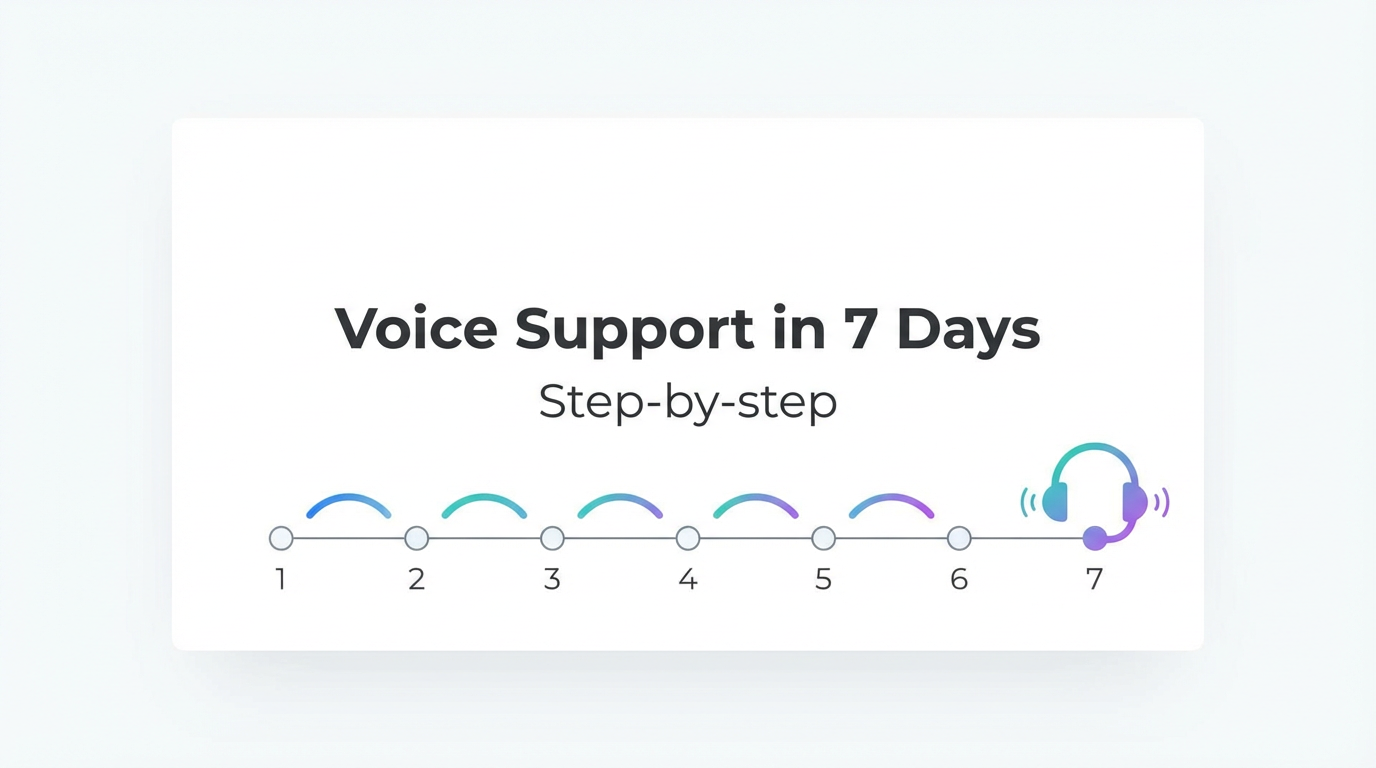
Putting It All Together: A 7-Day Story Day 1, you pick the battles you can win—Tier 1 FAQs, lead screening, and scheduling. You baseline AHT, FCR, CSAT, and cost per contact so your future success isn’t just a feeling; it’s measured. Day 2, you write conversational scripts that sound human, create guardrails for the scary stuff (refunds, billing), and map your flows. Day 3, you connect your telephony, CRM, calendar, ERP/order system, and ticketing; everything logs cleanly to the CRM with consent and survey data stamped like a passport.
On Day 4, you build your “LEGO set”: lead scoring and booking, appointment flows, password resets, order status, and a friendly CSAT/NPS wrap-up. By Day 5, you’ve run test calls until you can predict the outcomes: 80%+ accuracy, proper CRM updates, and alerts if something goes strange. Day 6, you launch to a small cohort and train your team to hand off, override, and annotate errors. Every transcript is a lesson. Day 7, you tune prompts, automate follow-ups, publish your documentation, and widen your coverage as you head into a disciplined 30-day pilot.
Common Pitfalls (And How to Dodge Them)
- Launching too many workflows at once → Start with one, expand after metrics stabilize
- Poor data quality → Clean and validate; version control your knowledge base
- No human oversight → Define escalation and approval rules for critical decisions
- Undefined success metrics → Set AHT, FCR, CSAT, containment, and ROI targets on Day 1
- Lack of monitoring → Implement dashboards, error alerts, and audit trails before go-live
- Change resistance → Communicate WIIFM, train generously, highlight quick wins
Conversation Snippets You Can Steal
- Appointment: “I can book you for Tuesday at 2 PM or Wednesday at 10 AM. Which works?”
- Lead qualification: “To make sure we’re a fit, may I ask about your timeline and budget?”
- Disqualification (graceful): “It sounds like you’re not ready yet. I’ll email resources so you can revisit when it’s right.”
- Survey invite: “Thanks for the chat. Would you rate your experience from 0–10? A quick score really helps us improve.”
How to Expand After Week 1
- Add internal ops in overflow hours: HR onboarding walkthroughs, IT password unlocks, policy updates
- Deepen Tier 1: more FAQs, self-serve returns, shipping label generation
- Add proactive outreach: reminder calls, renewal nudges, payment follow-ups (with consent)
- Build a feedback-to-roadmap loop: tag verbatims and feed product priorities
Executive Snapshot: Why This Works
- Economics: 30–50% support cost reduction; 30–40% OpEx down in broader automation
- Scale: 24/7 coverage with unlimited concurrent calls; no queue anxiety
- Experience: Faster response (−50–70%), shorter AHT (−35–45%), higher FCR (+20–40%), and happier agents doing more interesting work; customers get instant clarity for simple needs (and 47% prefer AI for exactly those)
- Risk management: Guardrails, human oversight, audit trails, and transparency maintain trust and compliance
- Time to value: ROI-positive within 90 days is the norm for disciplined pilots; top performers see up to 8X ROI
Quick Read Checklist (Print This)
- Day 1: Scope three workflows; baseline KPIs; assemble source content
- Day 2: Map intents; write scripts; set guardrails and handoff rules
- Day 3: Connect telephony, CRM, calendar, ERP/order, ticketing; configure data writes and consent storage
- Day 4: Build flows (qualification, scheduling, Tier 1, surveys); add error handling and events
- Day 5: Test E2E; hit 80%+ accuracy; enable monitoring and alerts
- Day 6: Pilot to a cohort; train teams; review transcripts daily
- Day 7: Optimize prompts; automate follow-ups; finalize documentation; expand coverage and use cases
Conclusion: Seven Days to a Smarter Hotline In one week, you can ship a voice agent that picks up every time, handles Tier 1 questions without breaking a sweat, qualifies leads, books meetings, runs surveys, and updates your CRM—reliably and at scale. The payoff is tangible: lower costs, faster answers, happier customers, and agents freed from repetitive drudgery. Start small, measure everything, and iterate daily. In 30 days, you’ll have the data to expand confidently—and the story to bring your organization along.
If your customers could talk to your brand at any hour and get what they need in minutes, would that change your quarter? Good news—you can make that your reality in seven days.