
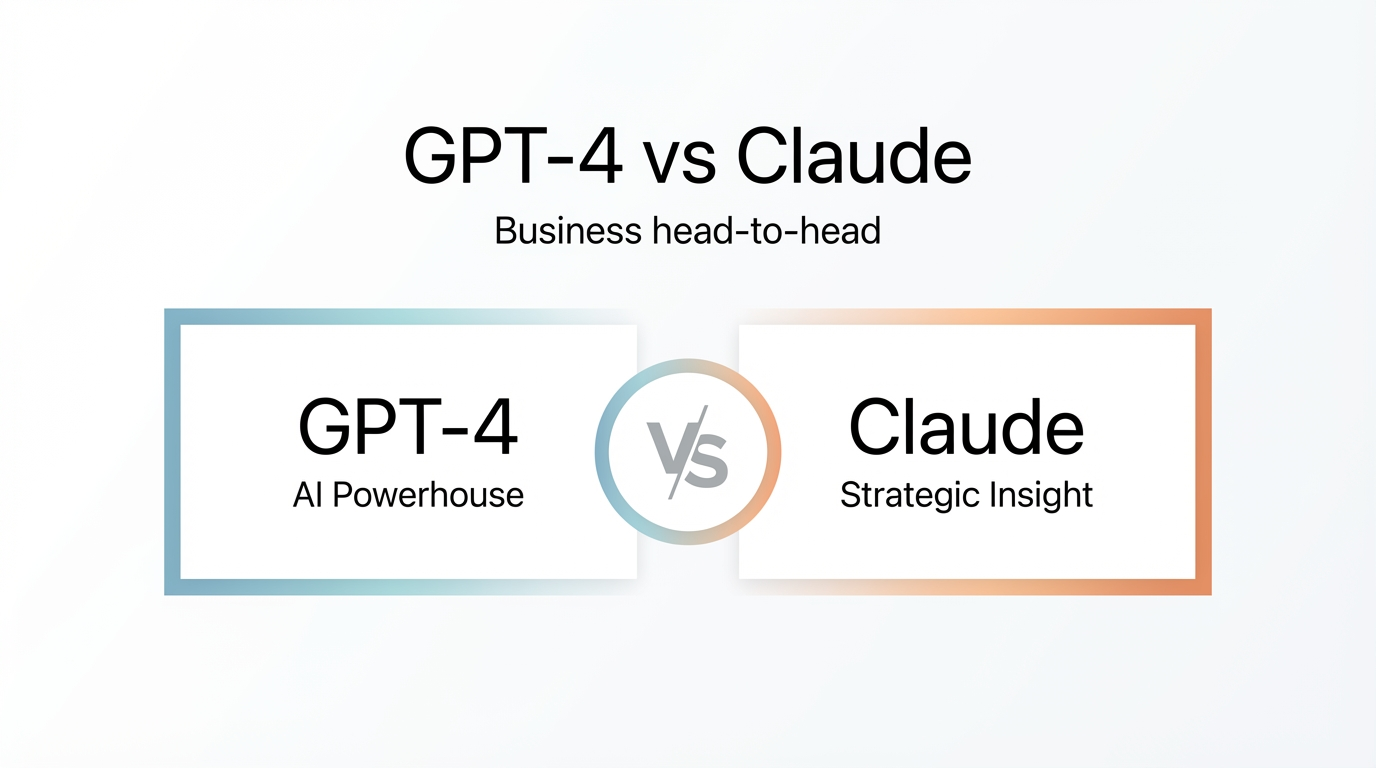

GPT-4/4o vs Claude 3.5: Head-to-Head for Business Applications
If you’re choosing between GPT-4/4o and Claude 3.5 Sonnet for your business, it can feel like picking between two seasoned executives for a critical role. Both are wildly capable. Both are trusted by serious teams. And both will change how your organization works this year. The real question isn’t which model is "best"—it’s which one is best for your use case, constraints, and culture.
Let’s go beyond the hype and make this practical.
Executive Summary (TL;DR for busy leaders)
- Both GPT-4/4o (OpenAI) and Claude 3.5 Sonnet (Anthropic) are top-tier LLMs suitable for enterprise use.
- Benchmarks are close: GPT-4o edges overall (88.5/100 vs 87.3/100) and excels at general-purpose reasoning, creative writing, and coding.
- Claude 3.5 differentiates with a safety-first design, a longer 200K-token context window, nuanced understanding, and strong performance on sensitive or compliance-heavy tasks.
- Pricing and access: Both offer $20/month consumer plans (ChatGPT Plus, Claude Pro) and pay-per-use APIs. Claude publishes per-million token pricing; OpenAI lists per-1K token pricing.
- Simple guidance: Choose GPT-4/4o for best overall performance and consistency across broad use cases. Choose Claude 3.5 for long-context analysis, safety-sensitive workflows, and enterprise governance needs.
Meet the Models: What You’re Actually Buying
Think of these models like two world-class consultants with different specialties.
GPT-4 / GPT-4o (OpenAI)
- Pricing (API): Input $0.01–$0.03 per 1K tokens; Output $0.03–$0.06 per 1K tokens
- Consumer: ChatGPT Plus $20/month
- Context window: Up to 128K tokens
- Strengths: Superior general reasoning, excellent creative writing, strong coding, multi-turn conversation strength, large ecosystem and adoption
- Best for: Enterprise apps, high-quality content, complex reasoning, multi-turn conversations, code generation
- Pros: Best overall performance; reliable and consistent; strong documentation; wide adoption; regular updates
- Cons: Not open source; API costs can add up; rate limits on free tier; privacy concerns for highly sensitive data
Claude 3.5 Sonnet (Anthropic)
- Pricing (API): Input $3 per million tokens; Output $15 per million tokens
- Consumer: Claude Pro $20/month
- Context window: Up to 200K tokens
- Strengths: Safety-first (Constitutional AI), nuanced understanding, excellent coding, strong long-document processing
- Best for: Sensitive content; legal/compliance work; research and analysis; long-document processing; code generation and review
- Unique: Constitutional AI for alignment and safety
- Pros: Very safe outputs; longest context window (200K); excellent at coding; strong reasoning; enterprise-friendly for compliance
- Cons: Not open source; limited availability in some contexts; slower than GPT-4 in some cases; API can be expensive
The Scoreboard: Benchmarks at a Glance
- Overall performance scores:
- GPT-4o: 88.5/100
- Claude 3.5 Sonnet: 87.3/100
- Both models perform at the top on MMLU (knowledge), HumanEval (coding), MATH, and reasoning tasks.
Interpretation: These are both elite. GPT-4o typically wins by a nose on generalized tasks and creative range, while Claude 3.5 shines where care, nuance, and policy alignment matter most.
Capabilities That Matter in Business
1) Reasoning and Accuracy
- GPT-4/4o: Leading general performance; dependable across complex, multi-step tasks. If your workflows mix creative generation, analysis, and code, GPT-4/4o is a confident default.
- Claude 3.5: Strong reasoning with an emphasis on safe, policy-aligned outputs. Exceptionally good for high-stakes contexts where a careful tone and compliance alignment are non-negotiable.
Analogy: GPT-4/4o is the Swiss Army knife you trust for nearly every job; Claude 3.5 is the high-precision instrument you pull out when an auditor is watching.
2) Context Window and Long-Document Work
- GPT-4/4o: 128K tokens—more than enough for most business conversations and complex prompts.
- Claude 3.5: 200K tokens—huge advantage for reviewing lengthy contracts, multi-document research, due diligence packs, or discovery in legal workflows.
If your team spends time wrangling 100+ page documents, memos, and attachments, Claude’s 200K window reduces fragmentation and preserves nuance.
3) Coding and Code Review
- Both: Excellent for code generation, refactoring, unit test creation, and code review. Each appears in “Best for Coding” shortlists in practical selection frameworks.
If you’re building developer copilots or CI/CD bots, you’ll likely be happy with either model. Many teams pilot both and choose based on ergonomics, latency, and in-house eval scores.
4) Safety, Compliance, and Governance
- GPT-4/4o: Enterprise-ready with strong documentation and controls. Some privacy concerns are cited for highly sensitive data; ensure proper data governance.
- Claude 3.5: Safety-first design via Constitutional AI, which bakes in policy alignment and safer defaults. Highly appealing for legal, compliance, healthcare, and finance teams.
This is often the deciding factor for regulated industries. Claude’s outputs tend to be more conservative and policy-shaped out of the box.
5) Multimodal and Ecosystem
- GPT-4/4o: Broad adoption, mature ecosystem, strong multi-turn conversation capabilities, and general-purpose versatility across business functions.
- Claude 3.5: Emphasizes safe, nuanced language interactions; resonant in enterprises where content sensitivity is paramount.
If you value community examples, integrations, and vendor support breadth, GPT-4/4o’s ecosystem gravity is hard to ignore.
Pricing: What You’ll Actually Pay
- GPT-4/4o (API):
- Input: $0.01–$0.03 per 1K tokens
- Output: $0.03–$0.06 per 1K tokens
- Consumer plan: ChatGPT Plus $20/month
- Considerations: Costs can add up at scale; rate limits on free tier
- Claude 3.5 Sonnet (API):
- Input: $3 per million tokens
- Output: $15 per million tokens
- Consumer plan: Claude Pro $20/month
- Considerations: API can be expensive; availability constraints in some regions/contexts
A quick mental model:
- OpenAI posts per-1K token rates; Anthropic posts per-million rates. Converting Anthropic’s numbers: $3/million input ≈ $0.003/1K; $15/million output ≈ $0.015/1K.
- Your bill depends on total tokens processed. Claude’s long context can invite larger prompts (big uploads), while GPT’s multi-turn strengths can lead to more conversational turns. Either way, plan for scale.
Illustrative example (not a quote, just math):
- Suppose a single analysis involves ~200K input tokens and 10K output tokens.
- Claude 3.5 cost ≈ (0.2m × $3) + (0.01m × $15) = $0.60 + $0.15 = $0.75
- GPT-4/4o cost ranges with tier; if we assume mid-tier averages (say $0.02/1K input, $0.05/1K output):
- Input: 200K × $0.02/1K = $4.00
- Output: 10K × $0.05/1K = $0.50
- Total ≈ $4.50
In this toy scenario, Claude looks cheaper, but many workflows require chunking and multiple passes with either model. The safe takeaway: at volume, both can be expensive. Monitor tokens, compress prompts, and choose the right model per task profile.
Enterprise Considerations: What Leaders Ask First
Security and Safety
- GPT-4/4o: Reliable and well-documented with enterprise controls, but some organizations cite privacy concerns for highly sensitive data.
- Claude 3.5: Designed with safety-first principles (Constitutional AI), a favorable posture for regulated industries and compliance-heavy workflows.
Availability and Performance
- GPT-4/4o: Widely available, consistent performance, and regular updates.
- Claude 3.5: Limited availability in some contexts and noted as slower than GPT-4 in certain scenarios. Plan for this in latency-sensitive apps.
Vendor Lock-in and Open Source
- Both: Not open source.
- If data privacy and customization are paramount, evaluate a self-hosted Llama strategy alongside vendor models. Some organizations blend both: Llama for internal, sensitive data enclaves; GPT/Claude for tasks benefiting from frontier performance.
Use-Case Mapping: When to Choose Which
Choose GPT-4/4o when:
- You need best-in-class general performance across varied tasks.
- Your workflows mix creative generation, complex reasoning, and code.
- You value wide ecosystem support, documentation, and predictable reliability at scale.
Choose Claude 3.5 Sonnet when:
- You must process very long documents (200K context advantage).
- Safety, legal, and compliance guardrails are critical.
- You need nuanced interpretations and careful handling of sensitive content.
For mixed needs, use both:
- Route long-context, compliance-heavy tasks to Claude 3.5.
- Route broad creative, coding, and general reasoning tasks to GPT-4/4o.
Quick Decision Checklist
- Need the longest practical context window? → Choose Claude 3.5.
- Prioritize top overall benchmark performance and creative range? → Choose GPT-4/4o.
- Is safety/compliance your primary constraint? → Choose Claude 3.5.
- Want broad ecosystem support and predictable reliability at scale? → Choose GPT-4/4o.
- Cost-sensitive at very high volumes? → Compare per-token pricing and usage patterns; both can be expensive at scale.
Case Studies and Illustrations
Let’s put this in real-world shoes.
Case 1: “When Safety Trumps Speed” — A Regulated Finance Team
A mid-sized wealth management firm needs an AI to analyze complex regulatory updates and generate policy summaries for advisors. Content is sensitive, tone matters, and legal nuance is crucial.
- Challenge: Long, dense documents; strict compliance; low tolerance for risky outputs.
- Choice: Claude 3.5 Sonnet for its safety-first design (Constitutional AI) and 200K context window.
- Outcome: Analysts upload entire regulatory packets (hundreds of pages) in one go. Claude provides summaries with citations, flags ambiguous sections, and suggests policy updates that align with internal guidelines. The team appreciates the conservative, policy-aligned style.
- Why not GPT-4/4o? It could do the job, but the firm prioritized maximal context per request and safety posture over marginal benchmark performance differences.
Case 2: “Creative and Code Workflows at Scale” — A SaaS Product Team
A B2B SaaS company wants to automate marketing content, streamline support responses, and add a code assistant for internal developer productivity.
- Challenge: Varied tasks (creative writing, reasoning, code), fast iteration, and ecosystem integrations.
- Choice: GPT-4/4o for general-purpose excellence, creative range, and strong coding.
- Outcome: Marketing uses GPT-4/4o to draft campaigns, product uses it for feature specs and UI copy, and engineering plugs it into CI for refactoring and unit test generation. The team leverages the mature ecosystem and documentation to move quickly.
- Why not Claude 3.5? Claude is strong here too, but the company valued GPT-4/4o’s broad versatility and ecosystem momentum to standardize across departments.
Case 3: “The Two-Model Play” — A Healthcare Network’s Mixed Needs
A healthcare network needs both extremes: nuanced, safety-aligned clinical summaries and creative patient education content, plus code automation for internal tools.
- Challenge: Balance compliance-heavy tasks with general productivity.
- Choice: Both. Claude 3.5 handles clinical policy summaries and long-document reviews. GPT-4/4o powers patient-facing content and developer copilots.
- Outcome: A routing layer sends long-context or sensitive content to Claude; creative/coding tasks to GPT-4/4o. Finance sees manageable costs because each task goes to the most efficient model for that job.
Implementation Patterns That Work
- Start with a pilot: Benchmark both models on your top 5 use cases (content, analysis, code, support, research). Score outputs on accuracy, tone, latency, and cost.
- Design for routing: Add a simple decision layer that chooses the model by task. Example: >100 pages or compliance context → Claude; everything else → GPT.
- Measure token flow: Log tokens per call, and review weekly. Often, prompt compression and smarter chunking cut costs by 20–40% without quality loss.
- Build guardrails: Even with Constitutional AI or strong docs, set policies, human-in-the-loop steps, and audit logs.
- Plan for governance: Define where sensitive data lives. For the highest-sensitivity tasks, consider a self-hosted Llama instance inside your data boundary.
Key Stats You Can Cite
- Benchmark scores: GPT-4o 88.5/100; Claude 3.5 Sonnet 87.3/100.
- Context windows: GPT-4/4o 128K; Claude 3.5 Sonnet 200K.
- Pricing:
- GPT-4/4o API $0.01–$0.03 (input) and $0.03–$0.06 (output) per 1K tokens; ChatGPT Plus $20/month.
- Claude 3.5 Sonnet API $3 (input) and $15 (output) per million tokens; Claude Pro $20/month.
- Selection framework:
- Best Overall — GPT-4o or Claude 3.5 Sonnet (context-dependent)
- Best for Research (long context) — Claude or Gemini
- Best for Enterprise — Claude or GPT-4
Pros and Cons: Side-by-Side Snapshot
GPT-4/4o Pros
- Best overall performance and reliability
- Strong documentation and ecosystem
- Excellent creative writing and coding
- Regular updates and wide adoption
GPT-4/4o Cons
- Not open source
- API costs can add up
- Rate limits on free tier
- Privacy concerns for sensitive data
Claude 3.5 Sonnet Pros
- Very safe outputs; Constitutional AI alignment
- Longest context window (200K)
- Excellent coding and strong reasoning
- Enterprise-friendly for compliance
Claude 3.5 Sonnet Cons
- Not open source
- Limited availability in places
- Slower than GPT-4 in some cases
- API can be expensive
FAQs Leaders Ask
- Is one model clearly “better”? No. GPT-4/4o leads in overall benchmarks and creative/coding breadth, while Claude 3.5 leads for long-context and safety-first workflows. The winner depends on your priorities.
- Which is more cost-effective? It depends on usage. Claude’s per-million pricing may look favorable, but long-context workloads can drive large token counts. GPT-4/4o can also get expensive with many conversational turns. Monitor token usage either way.
- What about open source? Neither model is open source. If privacy and customization are critical, consider a self-hosted Llama alongside one or both.
Conclusion: A Practical Playbook for 2026
If you need one general-purpose model for diverse business applications—with top-tier performance, creativity, coding strength, and a mature ecosystem—choose GPT-4/4o. If your workflows revolve around sensitive content, legal/compliance, or very long documents—and you want the strongest default safety posture—choose Claude 3.5 Sonnet.
And for many organizations, the best answer is both. Route long-context, compliance-heavy tasks to Claude; route broad creative, coding, and general reasoning tasks to GPT-4/4o. Build a simple routing layer, keep an eye on tokens, and invest in governance. That’s how you turn two great models into one great strategy.
Final word: Don’t chase hype. Let your use cases, constraints, and metrics pick the model. That’s how modern AI actually delivers value.