
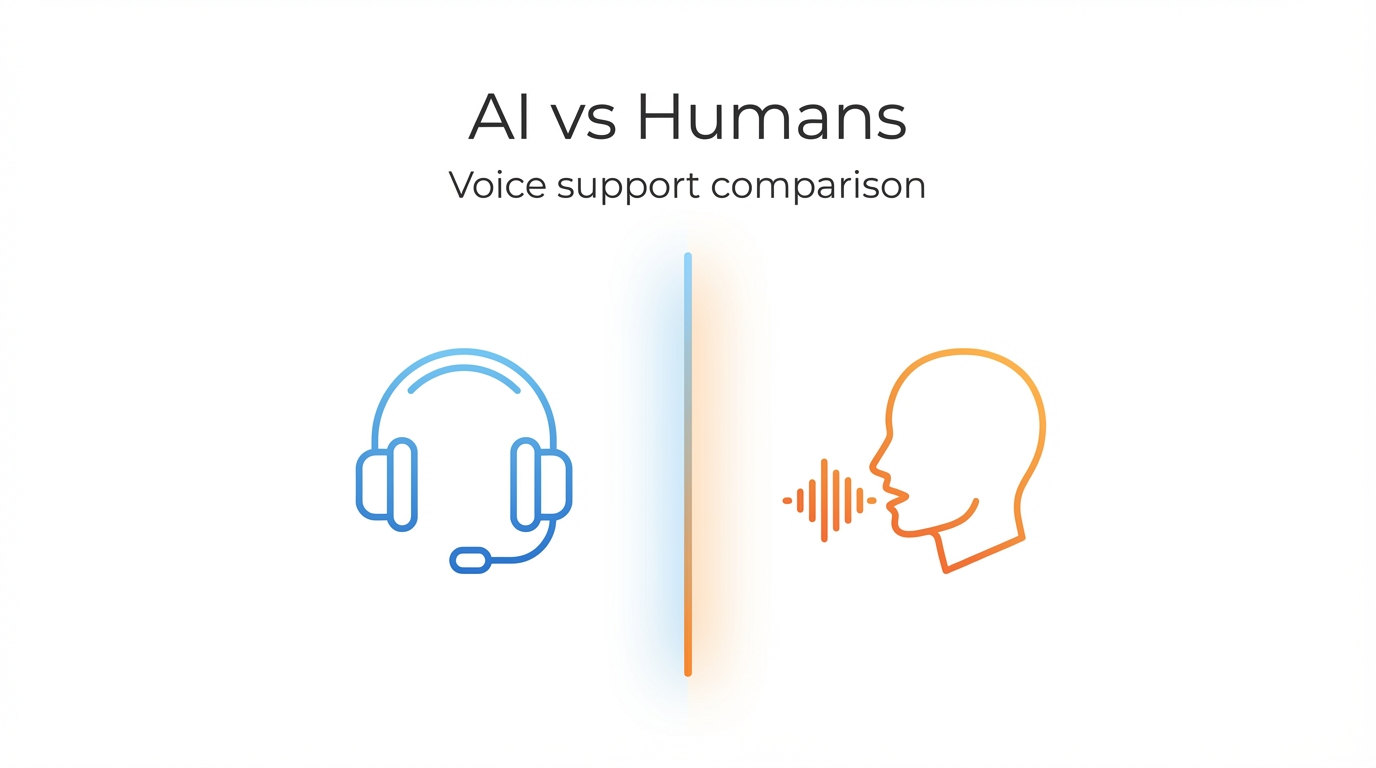

AI Voice Agents vs Human Agents: Cost & Performance Comparison
If your contact center were a restaurant, human agents would be the seasoned chefs—masters of nuance, capable of improvising complex dishes to delight demanding patrons. AI voice agents? They’re your high-speed fryers and line runners—always on, consistent, and brilliant at volume. The magic happens when your chefs and your line work together.
This post is your practical guide to deciding where AI voice agents fit next to your human team—costs, performance, ROI, and a simple 30-day pilot playbook you can actually run.
TL;DR Key Stats Snapshot
- Cost savings: 30–50% reduction in support costs when AI handles simple, repetitive calls
- Availability: 24/7 coverage, no added staffing
- Scalability: Unlimited concurrent calls; no queue during spikes
- AHT: 35–45% reduction on applicable call types
- CSAT: Neutral to positive for simple inquiries; 47% of users prefer AI for straightforward tasks
- Pilot targets: 50%+ time savings on targeted workflows, 80%+ accuracy, 70%+ user adoption, ROI positive within 90 days
- Data/process quality: Up to 88% accuracy improvement and 32% fewer human errors (broader automation benchmarks)
- Adoption momentum: 64% of businesses report positive impact from AI agents; early adopters report 3–5X efficiency gains on targeted tasks
The Business Case: Speed, Scale, and a Hybrid Reality
AI voice agents are increasingly deployed for customer-facing and internal calls: support, lead qualification, scheduling, surveys, and operational check-ins. They shine in high-volume, rules-based scenarios and bring measurable gains in handle time, concurrency, and cost.
But humans remain mission-critical for complex, sensitive, or judgment-heavy conversations—especially those that require deep empathy, exception handling, or bespoke problem-solving.
What most organizations actually implement: a hybrid model where AI acts as the front line for simple calls (containing as much volume as possible) and escalates seamlessly to human experts for the edge cases. It’s not man vs. machine; it’s man with machine.
Where AI Voice Agents Win (and Why Your CFO Smiles)
- Availability: 24/7 service with consistent quality—your line never sleeps
- Scalability: Unlimited concurrent calls; no more “please hold” during surges
- Speed: AHT reductions of 35–45% on applicable call types
- Consistency: Standardized responses reduce variability-driven errors
- User preference for simplicity: 47% of customers prefer AI for simple inquiries
These strengths translate into immediate operational relief in peak hours, better coverage across time zones, and less pressure to staff for surge or night shifts.
Where Human Agents Win (and Why Your Customers Stay)
- Complex, high-stakes, or ambiguous situations
- Nuanced empathy and sensitive topics
- Exception handling beyond defined workflows
- Relationship-building and consultative selling or support
In other words, when judgment, context, or emotions run high, humans remain the gold standard.
Core Use Cases for AI Voice Agents
- Lead qualification and enrichment (e.g., collecting firmographic data, routing high-intent leads)
- Appointment scheduling, reminders, rescheduling, cancellations, confirmations
- Customer service for simple, repetitive issues and multi-turn conversations (order status, password resets, basic troubleshooting)
- Post-interaction surveys, NPS collection, and feedback calls
- Internal operations calls: HR onboarding check-ins, IT helpdesk triage, policy communications, training delivery
Think of AI as the expert usher: it greets, guides, captures details, resolves the straightforward, and ushers complex cases to the right human, with context attached.
Cost Comparison: What You Actually Pay For
AI Voice Agents — Cost Drivers
- Subscription and usage: Base tool subscription plus pay-per-use for calls, minutes, or integrations
- Implementation: Initial setup, flows, and system integration time
- Training: Prompt/flow design and staff enablement
- Maintenance: Ongoing updates, monitoring, and optimization
ROI formula to keep it honest:
- ROI = (Gains - Cost) / Cost × 100
- Gains = (Hours Saved × Hourly Rate) + Error Cost Reduction + Opportunity Cost
- Cost = Tool Subscription + Implementation Time + Training + Maintenance
Observed outcomes from deployments:
- 30–50% reduction in support costs when AI handles simple and repetitive calls
- 24/7 availability without staffing premiums
- Unlimited concurrency that removes the need to scale headcount for spikes
Human Agents — Cost Drivers
- Direct staffing costs: salaries, benefits, shift differentials for nights/weekends
- Scheduling for surges/peaks: overstaffing or overtime to maintain SLAs
- Management overhead: workforce management, QA, team leads
- Training and onboarding: recurring costs for ramp and refreshers
- Quality assurance and error remediation: coaching, rework, and customer recovery
- Limited concurrency: one agent handles one call at a time; scaling requires more hires
Quick Illustration: The Numbers Behind the Pitch
Imagine 10,000 inbound calls/month, 60% of which are simple and rules-based (6,000 calls). Average handle time (AHT) for simple calls is 5 minutes.
- Baseline simple-call hours: 6,000 × 5 min = 30,000 minutes ≈ 500 hours/month
- With AI (35–45% faster), AHT could drop to ~3.25 minutes (35% reduction)
- AI-contained hours: 6,000 × 3.25 min = 19,500 minutes ≈ 325 hours (175 hours saved)
Let’s apply the ROI formula for a 30-day pilot:
- Hours Saved = 175 hours
- Hourly Rate (fully loaded) = $30
- Error Cost Reduction = $2,000 (fewer address/order entry mistakes; fewer callbacks)
- Opportunity Cost = $3,000 (human agents reallocated to revenue-generating tasks)
- Gains = (175 × $30) + $2,000 + $3,000 = $10,250
- Costs this month = $3,000 (subscription/usage) + $2,500 (implementation time) + $1,000 (training) + $500 (maintenance) = $7,000
- ROI = ($10,250 – $7,000) / $7,000 × 100 ≈ 46.4%
This is conservative. Many teams report 30–50% support cost reductions overall when AI takes on simple calls at scale and humans focus on complex work.
Performance and Quality Targets You Can Bank On
If you’re running a pilot, set clear success criteria:
- Accuracy: 80%+ (intent recognition, correct action)
- Adoption: 70%+ user acceptance for targeted workflows
- AHT: 35–45% reduction on scripted/simple calls
- Containment: 50%+ time savings on targeted workflows
- ROI: Positive within 90 days
- Data/process quality: Up to 88% accuracy improvement and 32% fewer human errors (from broader automation benchmarks)
What Happens to Your KPIs
For Teams Deploying AI Voice Agents
- AHT: 35–45% reduction on scripted/simple call categories
- Support Cost: 30–50% reduction by shifting routine volume to AI
- CSAT: Neutral to positive for simple inquiries; remember 47% prefer AI for straightforward tasks
- Scale and Coverage: Immediate surge handling and 24/7 service without extra staff
For Human-Only Teams
- Higher operating costs to maintain 24/7 or surge coverage
- Longer wait times during peaks; harder to scale concurrency
- Greater variability in call quality; higher QA and training overhead
Case Studies (Composite, Based on Real Implementations)
- Healthcare Scheduling at Scale
- Challenge: A regional clinic network handled 15,000 monthly calls for appointment reminders, rescheduling, and confirmations. Peaks caused long wait times and missed appointments.
- Solution: An AI voice agent managed reminders, two-way rescheduling, and insurance verification for straightforward cases. Complex insurance disputes and special accommodations escalated to human coordinators.
- Results: 24/7 coverage; AHT dropped 40% for scheduling calls; no wait times during morning spikes; missed appointments reduced, contributing to better clinic utilization. Support costs decreased ~35% for the targeted workflows. CSAT remained stable as complex cases still reached humans.
- E-commerce Order Status and Returns Triage
- Challenge: 60% of calls were “Where’s my order?” or basic return policy questions.
- Solution: AI voice agent authenticated users, checked order status, initiated simple returns, and triggered RMA instructions. Exceptions (damaged, missing items) routed to human agents with the case note prefilled.
- Results: 70% of simple calls fully contained by AI, AHT down 38% for those interactions, and human agents spent more time resolving complex cases on first contact. Support costs down ~40% within 90 days.
- B2B Lead Qualification and Routing
- Challenge: Sales ops struggled to follow up on inbound leads quickly and at scale, especially after-hours.
- Solution: AI voice agent performed initial qualification calls (company size, use case, timeline, budget signals), enriched CRM records, and booked meetings for qualified leads.
- Results: 24/7 response; faster speed-to-lead; pipeline efficiency improved with cleaner data and fewer no-shows thanks to automated confirmations and reminders. Early adopters reported 3–5X efficiency improvements for qualification tasks.
- Internal IT Helpdesk Triage
- Challenge: First-response SLAs suffered during software rollouts.
- Solution: AI voice agent handled password resets, outage announcements, and policy communication, escalating non-standard tickets to humans with context and logs.
- Results: 32% fewer human errors in ticket categorization; 88% improvement in data accuracy for ticket fields. IT staff regained time for complex incidents.
The Practical Decision Guide
Choose AI Voice Agents when:
- Call types are simple, repetitive, rules-based, and high-volume
- You need 24/7 coverage and surge capacity
- You must reduce AHT and support costs quickly
- You can clearly define success metrics and implement guardrails
Choose Human Agents when:
- Calls require deep empathy, complex judgment, or sensitive handling
- Policies are fluid and not yet codified into clear rules
- Escalations and exception handling dominate the workload
Choose a Hybrid Model when:
- You want AI to contain simple calls and pre-qualify leads, with seamless human handoff
- Your goals include cost savings, improved coverage, and maintained CSAT for complex scenarios
Tip: For most organizations, “Hybrid by Design” is the sweet spot.
Implementation Best Practices You Can Copy-Paste
- Identify High-Impact Call Types
- Look for repetitive, rules-based, high-volume calls with clear decision points and measurable KPIs
- Examples: password resets, order status, appointment management, basic troubleshooting, lead qualification
- Heuristic: If it repeats and it’s boring, it’s a candidate for AI
- Run a 30-Day Pilot (Yes, Just 30 Days)
- Define success metrics up front: AHT, containment rate, CSAT, accuracy, and ROI
- Measure baseline performance for the selected workflows
- Target success: 50%+ time savings, 80%+ accuracy, 70%+ user adoption, ROI positive in 90 days
- Keep scope tight: 1–3 workflows, one integration path, clear escalation rules
- Measure ROI Rigorously
-
Use the ROI formula consistently:
-
ROI = (Gains - Cost) / Cost × 100
-
Gains = (Hours Saved × Hourly Rate) + Error Cost Reduction + Opportunity Cost
-
Cost = Tool Subscription + Implementation Time + Training + Maintenance
-
Track hours saved, error reduction, and opportunity gains (e.g., more sales calls handled)
-
Monitor usage, minute costs, and any rework due to errors to keep your TCO honest
- Add Guardrails and Oversight
- Human-in-the-loop for critical decisions and sensitive cases
- Error detection and alerts, rollback procedures, audit trails, and compliance checks
- Real-time dashboards for performance, usage, and cost tracking
- Ensure Data Integrity
- Clean and validate data; maintain version control and backups
- Staged testing in pre-production before go-live
- Document data flows for audits and governance
- Change Management That Actually Changes Things
- Communicate WIIFM (What’s In It For Me) to your team
- Train agents to work alongside AI; address concerns directly
- Celebrate quick wins; iterate based on feedback to improve containment and accuracy
Your 30-Day Pilot Playbook
Week 0 (Prep):
- Pick 1–3 workflows (e.g., appointment rescheduling, order status, password resets)
- Map decision trees and edge cases; define escalation triggers
- Connect to necessary systems (CRM, scheduling, order management)
- Set baselines for AHT, containment, CSAT, accuracy
Week 1:
- Soft launch during business hours with human oversight
- Track intent recognition accuracy and transfer rates
- Fix misroutes, tune prompts, and tighten escalation rules
Week 2:
- Expand hours; start after-hours coverage
- Add error alerts and health checks; validate audit trails
- Review data integrity: Are CRM fields and tickets filled correctly?
Week 3:
- Optimize: shorten confirmations, trim dead air, reduce over-clarification
- Measure midpoint KPIs and compare to baseline
- Prepare training updates for human agents and FAQs for customers
Week 4:
- Full 24/7 coverage for selected workflows
- Re-run KPI analysis: AHT, containment, CSAT, accuracy, ROI
- Decide go/no-go for expansion and finalize your guardrails and dashboard
Pilot Success Criteria:
- 80%+ accuracy, 70%+ adoption, 50%+ time savings, ROI positive within 90 days
The Hybrid Operations Blueprint
- Intelligent triage: AI greets, authenticates, and identifies intent
- Containment: AI resolves simple, rules-based inquiries end-to-end
- Smart escalation: Seamless warm transfer to humans with full context
- Skill-based routing: Match escalations to the right specialist
- Feedback loops: Every escalation teaches the AI what to contain next time
The Metrics Dashboard You’ll Show in Your Exec Meeting
Design a dashboard around five pillars:
- Volume and Coverage
- Total calls, AI-contained calls, escalation rate
- Peak vs. off-peak performance; 24/7 uptime
- Efficiency
- AHT by call type (AI vs. human vs. escalated)
- Concurrency utilization; minutes per resolution
- Quality and Satisfaction
- Accuracy (intent match, data entry correctness)
- CSAT for AI-contained calls vs. human-handled
- First-contact resolution; recontact rate
- Financials
- Monthly savings (hours saved × hourly rate)
- Error cost reduction
- Opportunity value (e.g., extra sales calls handled)
- ROI using the defined formula
- Risk and Compliance
- Escalations for sensitive calls
- Audit trail completeness and data integrity scores
- Alert count and resolution time for incidents
Cost Tuning Tips (Because Every Dollar Counts)
- Start with the highest-volume, simplest workflows to maximize early ROI
- Optimize prompts and dialog to reduce unnecessary turns
- Cache and reuse integrations where safe to reduce call duration
- Use confidence thresholds to avoid costly mistakes—escalate when in doubt
- Review minutes usage monthly; renegotiate tiers when volumes rise
Common Pitfalls (and How to Dodge Them)
- Pilots with fuzzy goals: Always set measurable targets and baselines
- Over-automation: If policies are fluid or edge cases dominate, start with humans
- Ignoring change management: Train, communicate, and support your agents
- No guardrails: Add human-in-the-loop for critical paths and ensure audit trails
- Dirty data: Validate and clean data before integration; test in staging first
What Adoption Looks Like in the Market
There’s a clear shift toward agentic AI systems. Early adopters often report 3–5X efficiency improvements on targeted tasks, and 64% of businesses say AI agents have had a positive impact. The strongest ROI shows up when AI handles simple inquiries while humans manage escalations and deeper conversations.
Quick Reference: Mapping Call Types to the Right Resource
- AI-First: Password resets, order status, appointment reminders, rescheduling, basic returns, coverage FAQs, policy confirmations, lead data enrichment
- Human-First: Billing disputes with context, emotionally charged cancellations, high-value B2B negotiations, ambiguous troubleshooting, privacy-sensitive scenarios
- Hybrid: AI pre-qualifies or captures context, human solves; AI follows up with confirmations and surveys
An Analogy to Remember
Think airport operations: AI is your automated security lane—fast, consistent, and indispensable for throughput. Human agents are your concierges—navigating edge cases, calming nerves, and solving problems that don’t fit the template. Together, they move more people, more safely, with better experiences.
Final Adoption Checklist
- Identify top 1–3 simple, high-volume, rules-based call types
- Define baseline KPIs and success targets (AHT, containment, accuracy, CSAT, ROI)
- Implement guardrails (human-in-the-loop, alerts, audit trails, compliance)
- Validate data flows; stage before production; document everything
- Train teams (WIIFM), roll out a 30-day pilot, iterate weekly
- Launch the dashboard and review results; expand gradually where ROI is strongest
Conclusion: The Hybrid Edge
AI voice agents deliver measurable gains in speed, scale, and cost for simple, repetitive calls—often reducing support costs by 30–50% and cutting AHT by 35–45%. Human agents remain irreplaceable for complexity, judgment, and empathy. The winning move for most teams is a hybrid strategy: AI on the front line with seamless human escalation.
Pilot smart. Measure ruthlessly. Add guardrails. When your chefs and your line work in sync, customers get served faster, your team focuses on the work that matters, and your cost structure gets leaner—without sacrificing the human touch that builds loyalty.